
Introduction: Acknowledge that every agency has a 'tech stack,' but pose the question: When does it become a liability instead of an asset?
Every agency owner has one. It’s a badge of honour, a carefully assembled collection of software that powers your business. Your tech stack. You've spent countless hours researching, testing, and integrating tools for every conceivable task, from lead generation to client reporting. But have you ever paused to ask a critical question: is your stack a growth engine, or is it secretly an anchor weighing you down? The line is finer than you think. What begins as a collection of assets can quickly morph into a complex web of subscriptions, data silos, and operational drag—a liability that costs more than just money.

The Old Way: The Hidden Costs of 'Tool Stacking'
The sticker price of your SaaS subscriptions is just the tip of the iceberg. The true cost of a fragmented tool stack lies hidden in the operational friction it creates every single day. These are the expenses that don't show up on an invoice but drain your resources, time, and momentum.
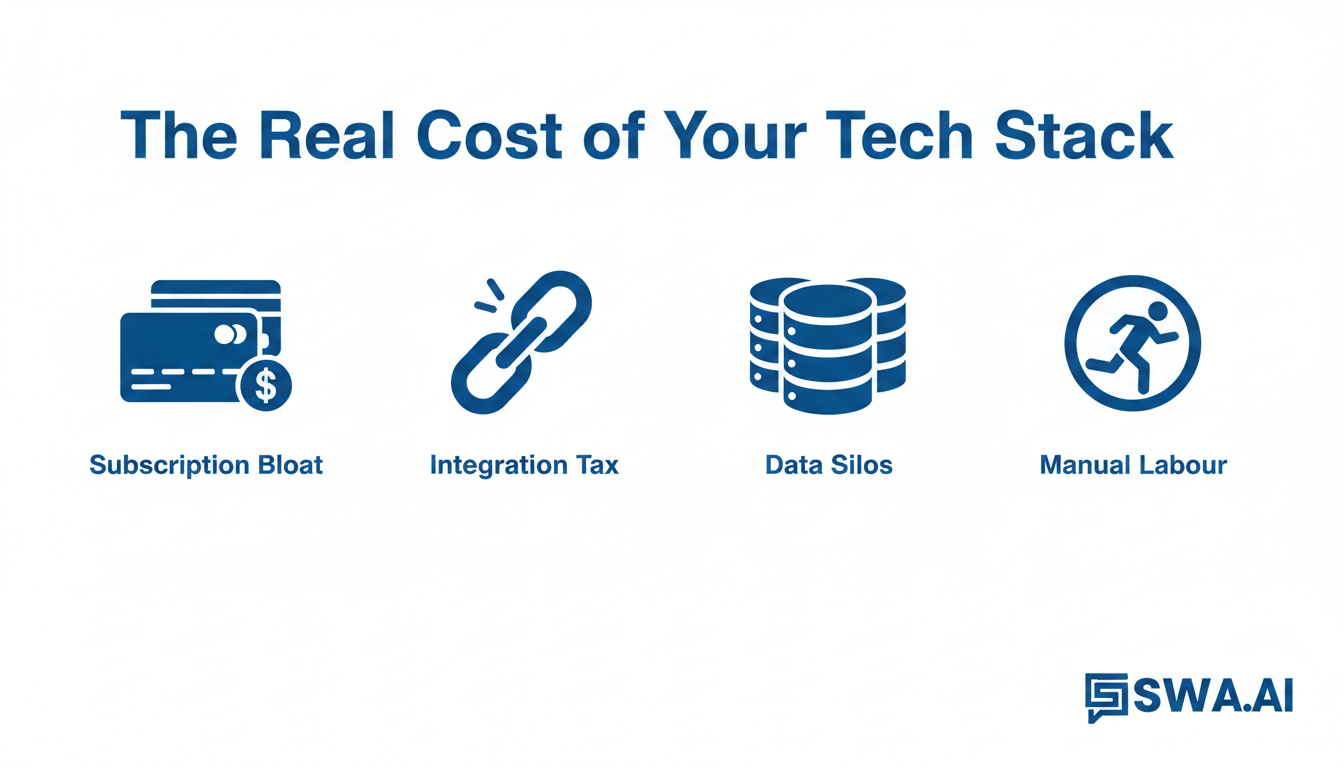
**Subscription Bloat:** It starts with a landing page builder, then an email autoresponder, a CRM, a scheduler, a reporting tool, and so on. Each subscription fee, while seemingly small on its own, adds up to a significant monthly overhead. You're often paying for overlapping features and entire platforms just to use 10% of their capability.
**The 'Integration Tax':** Getting these disparate tools to communicate is a nightmare. You're either paying for third-party connectors like Zapier, hiring developers for custom API work, or simply accepting that your systems won't talk to each other. This is a constant, invisible tax on your efficiency.
**Data Silos:** When your client data lives in a dozen different places, you have no single source of truth. Your acquisition data is in your ad platforms, your lead data is in your CRM, and your onboarding data is somewhere else entirely. This fragmentation makes optimisation nearly impossible and strategic decision-making a guessing game.
**Mandatory Manual Operation:** A disconnected stack requires a human operator to bridge the gaps. Your team spends hours manually exporting and importing CSVs, cross-referencing dashboards, and patching together reports. This isn't high-value work; it’s manual labour that keeps your most valuable people bogged down in operational weeds.
The New Way: The ROI of a 'Smart Execution Layer'
What if, instead of constantly stitching together different tools, you had a single, intelligent system that understood your strategy and handled the execution? That’s the premise of a smart execution layer. It’s not about adding another tool to the stack; it’s about replacing the entire fragmented model with a unified, intelligent core. The return on investment is immediate and transformative.
This approach fundamentally changes your agency's operational DNA. You benefit from a massive reduction in overhead by consolidating dozens of subscriptions into one. More importantly, you gain a single source of truth where all your business, client, and marketing data coexist, providing unparalleled clarity. With an execution layer, campaign deployment which used to take weeks of coordination can now happen in days, or even hours. Perhaps the most powerful benefit is the shift from relying on senior talent for complex execution. A smart system guides the process, allowing more junior team members to deploy sophisticated acquisition systems flawlessly, freeing up your experts to focus on strategy.
A Practical Example: Client Acquisition Funnel
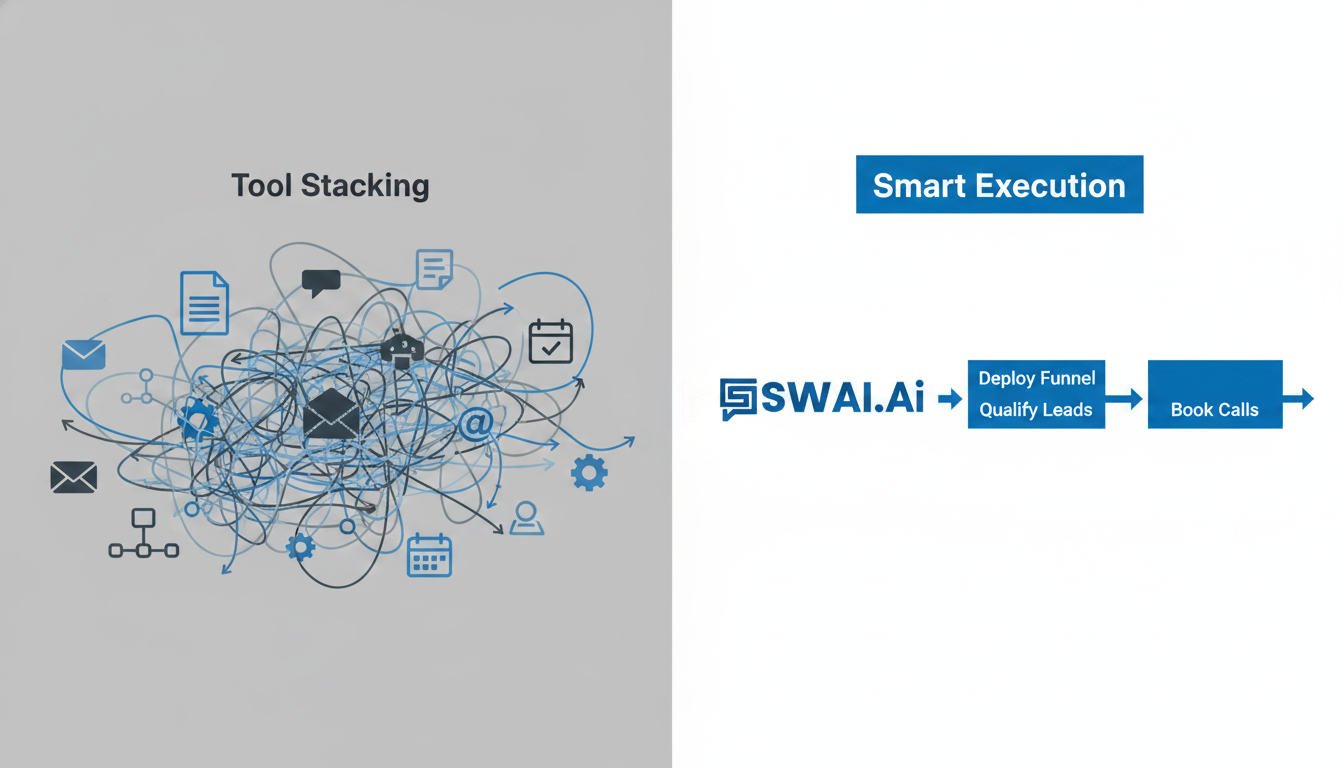
Let's contrast the process of launching a simple lead magnet funnel to book strategy calls. It’s a bread-and-butter campaign for any agency, but the execution differs dramatically.
The Tool-Stacking Approach:
**Build a landing page** in Leadpages or Instapage.
**Integrate it** with your CRM like HubSpot or ActiveCampaign.
**Create a 5-day email sequence** in your email tool, making sure the tags are firing correctly.
**Embed a Calendly link** in the final emails for booking.
**Set up Zapier** to create a new deal in your CRM when a call is booked.
**Try to track the entire journey** using Google Analytics, hoping the cross-domain tracking works.
This process involves at least four different subscriptions, multiple points of integration failure, and hours of technical setup and testing. It's fragile, complex, and difficult to optimise.
The Smart Execution Approach with SWAI:
**Define the objective:** “Create a funnel to book qualified calls for my ‘Agency Growth’ offer.”
**SWAI builds the entire system:** It deploys the landing page, writes and schedules the follow-up sequence, and integrates an AI qualifier and booking agent—all within a single, unified environment.
The system already understands your offer, your audience, and your goal. There are no integrations to manage and no data silos. It’s a single, seamless workflow from click to call, deployed in a fraction of the time.
Conclusion: The conversation needs to shift from 'what tools to use' to 'how you execute'. It's time to upgrade your agency's core operating system.
The debate in the agency world can no longer be about which email tool is best or what CRM has the most features. That’s the old conversation. The new frontier of competitive advantage lies in execution velocity and operational intelligence. Relying on a cobbled-together stack of disconnected tools is like trying to win a Formula 1 race with a car you built from scrap parts. It might run, but it will never compete at the highest level. It's time to stop being a systems integrator and start being a strategist again. It's time to upgrade your agency's core operating system from a liability into your most powerful asset.
Stop patching together systems and start deploying intelligent growth engines. If you're tired of the operational chaos and ready to see how a smart execution layer can transform your agency's capacity, you need to see it live. We build a complete customer acquisition system from scratch, every week. Witness the speed and power of a unified system in action. Join the Live build this Tuesday.
