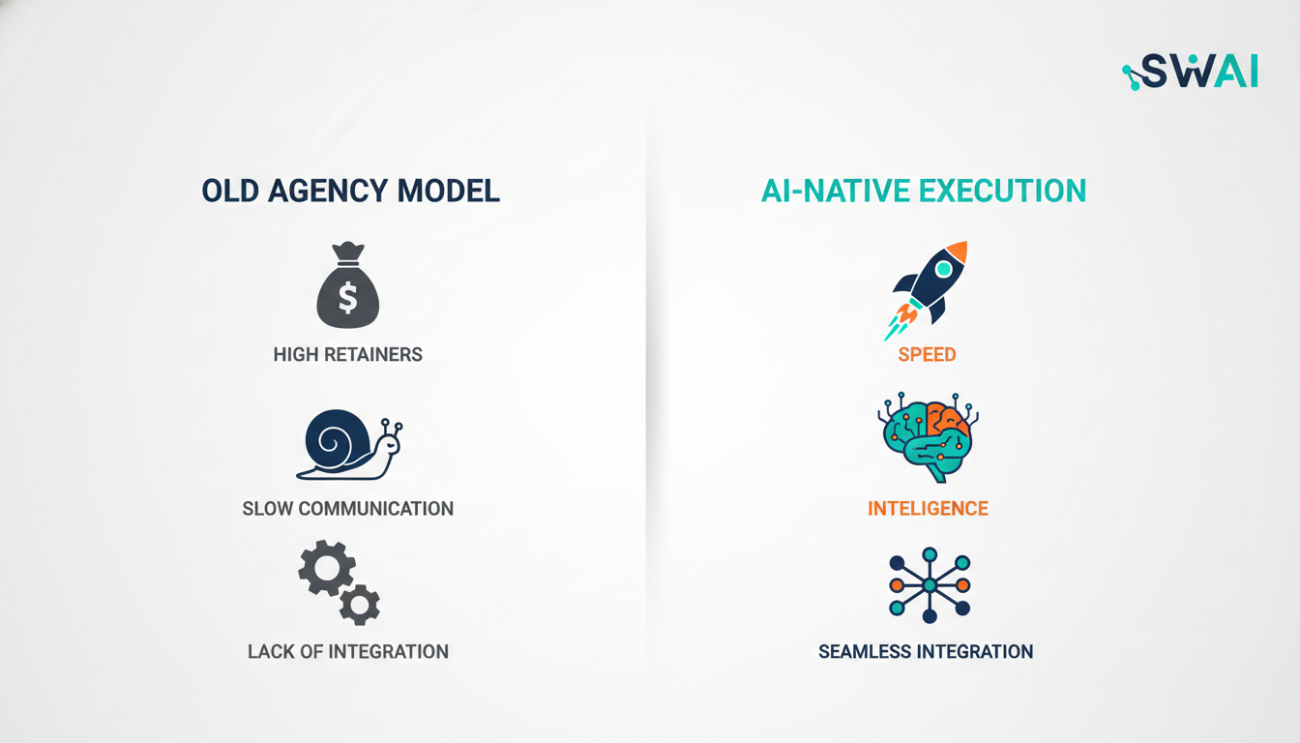
For decades, the playbook for growth was simple: when you needed to scale customer acquisition, you hired an agency. It was the default move. But for today's founder-led service businesses, that playbook is not just outdated—it's a liability. The traditional agency model, built on billable hours and human-led execution, is fundamentally breaking under the speed and intelligence of the AI-native era. This isn't just a disruption; it's a structural collapse. And for founders who see it, it represents the single biggest opportunity to build leverage and out-execute the competition.
The Flaws of the Old Playbook
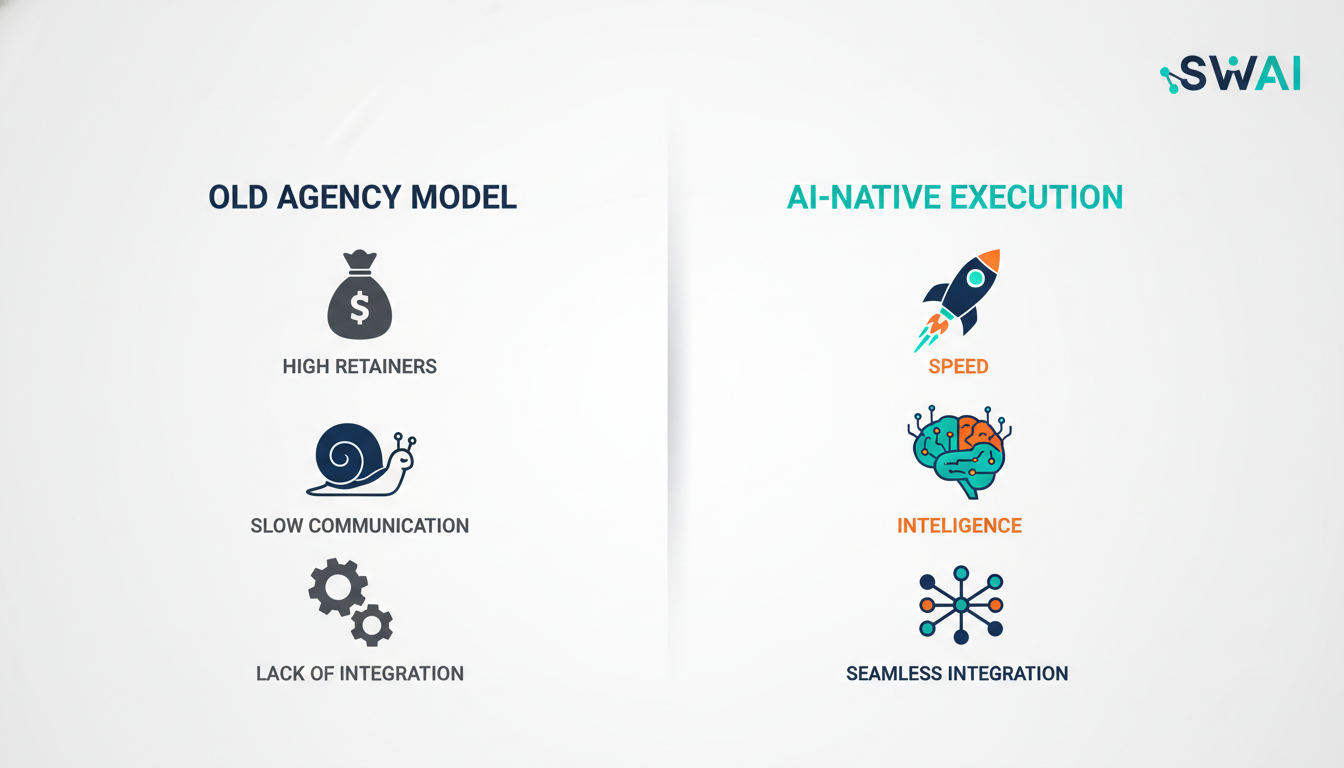
Let’s be honest about the friction inherent in the traditional agency relationship. It begins with steep retainers that often reward activity, not outcomes. Communication is slow, bogged down by account managers, email chains, and weekly meetings that could have been a dashboard. The systems they build for you are rarely integrated with your core operations, creating fragmented data and a disjointed customer experience. Worst of all, the entire model is built on an incentive mismatch: agencies profit from complexity and billable hours, while you need efficiency and results. This core conflict means you're paying for labor, not leverage, and it's a tax on your growth.
How AI Disrupted the Value Chain
The disruption isn't just about AI's ability to perform tasks. It's about how it has systematically dismantled the agency value chain. The core 'deliverables' that once justified high fees—copywriting, market research, ad creative, data analysis—have been largely commoditized by sophisticated AI models. Where an agency once needed a team of specialists, a single operator can now leverage AI to achieve similar, if not better, results in a fraction of the time. The bottleneck is no longer the creation of marketing assets; it's the deployment of cohesive, intelligent systems. Agencies built to sell human hours are finding their core offering has become a commodity, leaving them unable to compete on the new battlefield: execution speed.
The Rise of the In-House Execution System
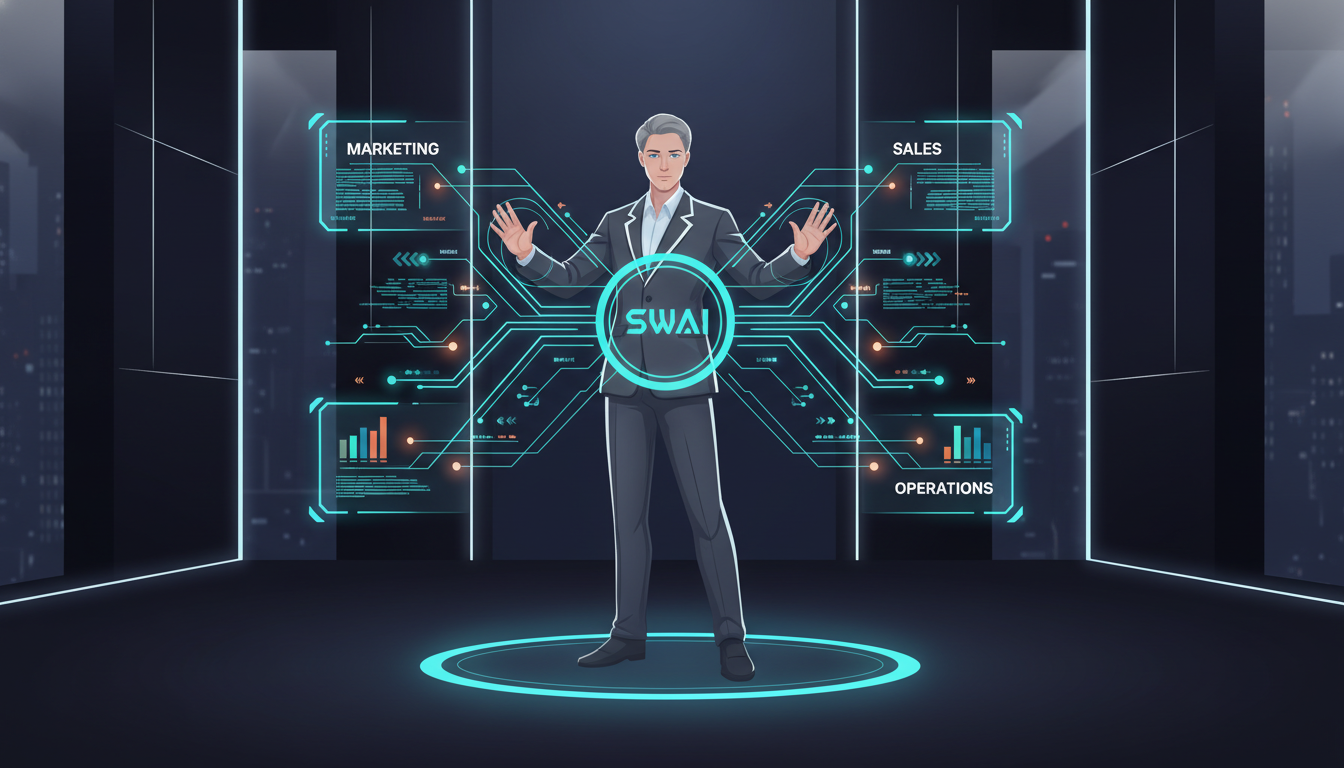
So, what replaces the agency? The answer isn't a bigger in-house team—it's a smarter in-house system. The new model sees founders moving from being clients to being commanders. Instead of outsourcing their growth engine, they are insourcing it by deploying a smart execution layer like SWAI. This layer acts as the central intelligence for the business, connecting strategy directly to customer acquisition without the bloat, delays, and misaligned incentives of an external team. It's a shift from renting expertise to owning execution capacity. You set the vision; the system handles the heavy lifting, from lead generation and qualification to funnel optimization and growth tracking.
What This Means for Your Business
Adopting an in-house execution system fundamentally changes your business's operational DNA. The most immediate impact is a dramatic increase in deployment speed. New campaigns, landing pages, and follow-up sequences can be launched in hours, not weeks. Second, you achieve superior results by operating from a single source of truth. With all your data in one place, the system can self-optimize based on real-time performance, a feat impossible with fragmented agency tools. Finally, you retain full ownership of your data, insights, and operational intelligence—your most valuable assets. This allows you to build a true competitive moat without the recurring overhead of retainers or the chaos of managing a sprawling team of freelancers and software.
Conclusion
The future of growth for founder-led businesses isn't about finding a better agency; it's about making the agency model obsolete. The shift is from outsourcing tasks to building owned, intelligent systems. This is 'smart insourcing'—equipping your business with the execution capacity to move faster, operate leaner, and scale with absolute clarity and control. The old playbook is broken, and those who adapt will gain an almost unfair advantage. The question is no longer if this change is coming, but whether your business is structured to capitalize on it.
Are you tired of the operational drag from disconnected tools and expensive retainers? The first step toward building your own AI-native growth engine is understanding your current bottlenecks. Take our AI-Native Readiness Audit to diagnose your operational weaknesses and discover your personalized path to escaping the broken agency model and achieving autonomous growth. See how you can build a business that truly executes.
