Introduction: The Dream vs. The Reality of Scaling
Every agency founder shares the same dream: a calendar packed with high-value clients and revenue charts that only go up. But for many, the reality of growth is far from glamorous. You start landing more clients, but instead of celebrating, you're drowning in operational chaos. Profit margins shrink, your team is stretched thin, and you find yourself working harder than ever just to keep things from falling apart. This is the agency scaling paradox: the very growth you chased is now the source of your biggest bottlenecks. You’ve hit the growth ceiling, where adding more clients just means adding more complexity, not more profit.
The Hidden Costs of Manual Work
The most significant drain on an agency's profitability isn't a line item on a spreadsheet; it's the cumulative effect of manual work. These repetitive, low-value tasks are silent profit killers, stealing time and introducing risks that scale alongside your client roster. Think about your daily operations:
**Manual Reporting:** Hours spent pulling data from a dozen different platforms, formatting spreadsheets, and triple-checking numbers. It’s a recipe for human error and a massive time sink that could be spent on high-level strategy.
**Client Onboarding:** Every new client kicks off a cascade of manual tasks—creating folders, setting up accounts, sending welcome emails. Inconsistency here leads to a poor client experience and sets a chaotic tone from day one.
**Inconsistent Follow-up:** Leads fall through the cracks because follow-up is manual and inconsistent. It’s a direct loss of potential revenue, all due to a lack of a reliable system.
These activities don't just consume time; they lead to team burnout, costly mistakes, and a ceiling on how many clients you can effectively serve. You're paying your talented team to be administrators, not strategists.
Why Your 'Franken-stack' of Tools is Leaking Revenue
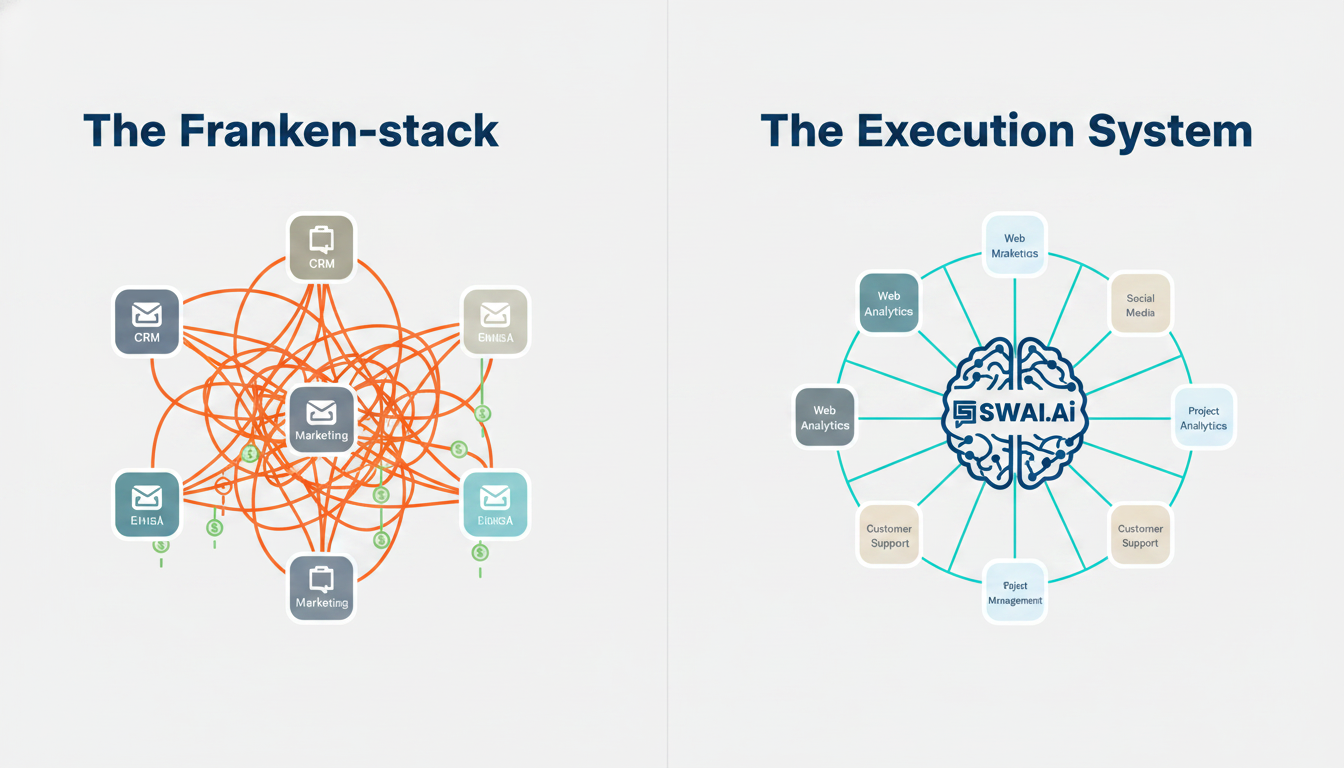
To combat the chaos, most agencies turn to software. The problem? They end up with a 'Franken-stack'—a monstrous collection of disconnected tools stitched together with hope and duct tape. You have one tool for social media, another for email, a separate CRM, a project management platform, and a half-dozen others. While each tool might be good at its one job, the combination creates more problems than it solves.
This fragmentation leads to critical issues. Data silos prevent you from getting a clear picture of your client journey or campaign performance. Subscription bloat has you paying for overlapping features and tools that are barely used. Most importantly, it creates operational complexity. Your team has to constantly switch between platforms, manually transfer data, and manage a dozen different logins. This friction slows down execution, frustrates your team, and ultimately, eats away at the very efficiency you were trying to create.
The Mindset Shift: From 'Doing' to 'Designing Systems'
Breaking through the scaling paradox requires a fundamental mindset shift. The solution isn't to hire more people to do the manual work or to add another 'magic' tool to your Franken-stack. The solution is to stop being the primary 'doer' and become the designer of your execution system.
True scale doesn't come from more effort; it comes from more leverage. It’s about building a single, integrated layer that handles the heavy lifting of customer acquisition—from lead generation and follow-up to reporting and optimization. When you have a smart system in place, you’re no longer just adding clients; you’re adding them to a predictable, repeatable, and profitable workflow. This shift frees you and your team from operational drag and allows you to focus on what truly matters: strategy, creativity, and delivering exceptional client results.

Conclusion: Escape the Paradox
Growing your agency should lead to more freedom and profit, not more chaos and burnout. The scaling paradox is a clear sign that your operational model is broken. Relying on manual work and a fragmented stack of tools is a path to stagnation. The only way to achieve profitable, sustainable growth is to move from fragmented tools to a unified execution system that works for you, not against you.
Tired of patching systems together and feeling like you're trapped in the day-to-day grind? It's time to see what's possible when you replace operational chaos with a smart execution layer. We're building the AI-native agency model live, showing operators exactly how to install systems for predictable growth. Join our Live build this Tuesday to see the future of agency operations in action and learn how to finally escape the scaling paradox.
