
Are You Scaling Your Team or Your Bottlenecks? The Case for an Operator-Less B2B Company
For most B2B founders, the growth equation seems simple: more revenue requires more people. To scale, you hire a Head of Marketing, build out a sales team, and bring in operations managers to coordinate it all. But what if this traditional playbook is fundamentally flawed? What if, by scaling your team, you're unintentionally scaling the very bottlenecks that slow you down? It's time to challenge the assumption that headcount is directly proportional to growth and explore a more powerful model: scaling revenue, not operational drag.

Unpacking the 'Human-Led' Growth Model
The conventional approach to growth relies on what can be called 'organized labor'—a complex web of talented individuals, specialized teams, and fragmented tools. While brilliant people are essential for strategy, relying on them for manual execution creates inherent inefficiencies. Every new hire adds a layer of complexity, increasing communication overhead and the risk of silos. This 'human-led' model is plagued by systemic issues:
**Coordination Tax:** Valuable time is lost in meetings, status updates, and emails simply to keep marketing, sales, and operations aligned.
**Execution Delays:** Manual processes, from launching campaigns to updating the CRM, are slow and prone to human error, creating a lag between decision and action.
**Siloed Data & Systems:** When each department uses its own set of tools, you end up with a fragmented view of the customer journey, making true optimization nearly impossible.
**High Operational Costs:** Beyond salaries, the cost of recruiting, onboarding, and managing a growing team, along with expensive agency retainers, eats directly into your margins.
Ultimately, this model forces founders to spend most of their time and resources managing the machine instead of directing its purpose.
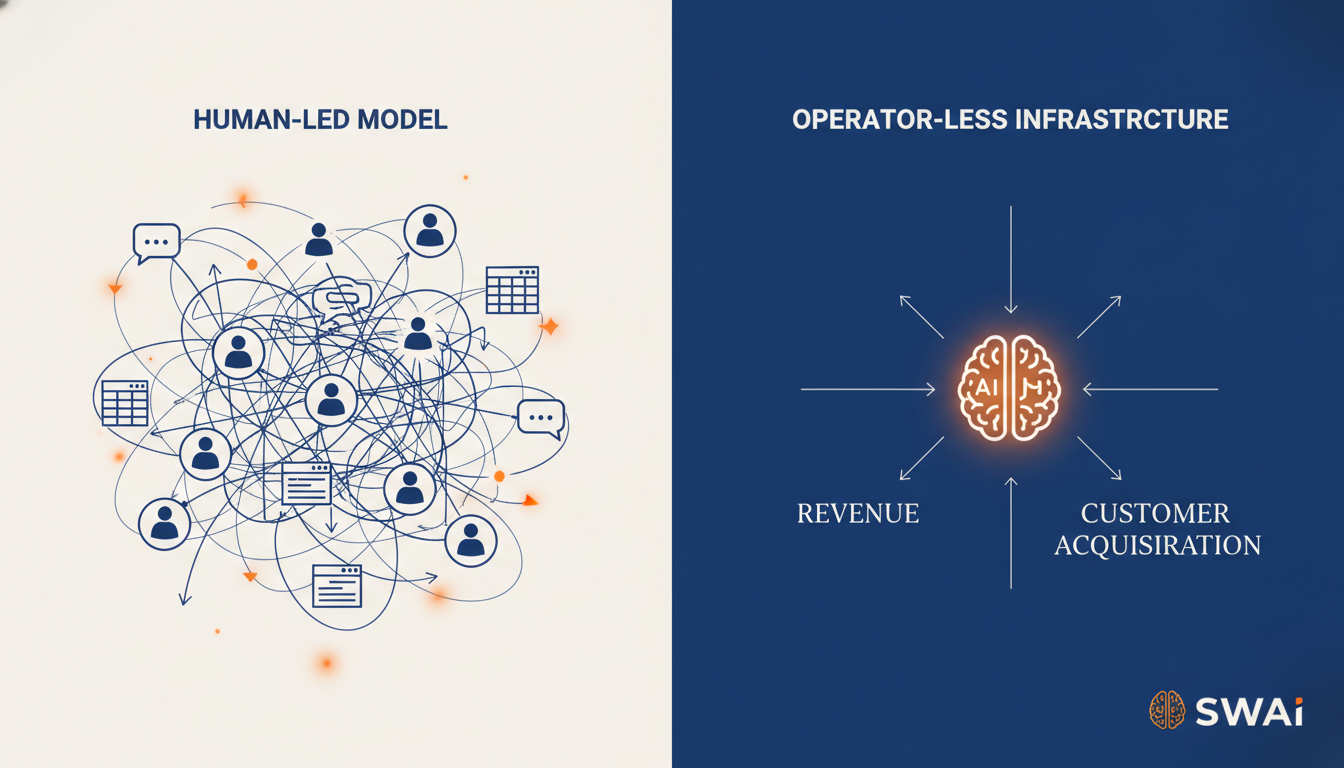
From Manual Coordination to Autonomous Operation
The alternative is not about replacing talented strategists; it’s about liberating them from operational friction. An AI-Native Revenue OS fundamentally restructures how growth is achieved. Instead of relying on human operators to run plays, it provides a unified, self-correcting infrastructure that builds, runs, and optimizes the entire customer journey autonomously. This isn't just another automation tool that patches a broken process. It's an entirely new architecture where AI-built pages, multi-channel traffic activation, and AI sales agents work in perfect concert, without the need for human coordination. The system itself becomes the operator, executing with a speed and precision that a human-led team simply cannot match.
What It Means to Deploy Growth vs. Manage It
When your growth engine is no longer dependent on 'organized labor,' a profound shift occurs in the founder's role. You stop being the chief coordinator and bottleneck-resolver. You are no longer bogged down by managing people, tools, and processes. Instead, you gain the strategic freedom to focus on what truly matters: vision, product, and market strategy. Deploying a growth infrastructure is like deploying an asset; you set the strategic direction, and the system executes and optimizes relentlessly to achieve it. This is the ultimate structural advantage—the ability to move at AI-speed, test hypotheses in real-time, and scale aggressively without the corresponding increase in operational complexity and cost. You transition from managing daily tasks to making high-value, strategic decisions.

The Infrastructure-First Future
The most agile and dominant B2B companies of the next decade won't be the ones with the largest teams, but those built on the most intelligent and autonomous infrastructure. The operator-less model offers a path to rapid, efficient, and sustainable scaling by transforming your growth function from a costly operational liability into a streamlined, self-correcting asset. It’s about building a company where growth is an inherent function of its design, not a constant managerial effort.
Is your current growth model a true asset, or is it a collection of operational bottlenecks waiting to break? The first step to gaining a structural advantage is to diagnose your current system's limitations. Assess your company's operational drag and discover your AI-Readiness score today to see how an operator-less infrastructure can unlock your true potential. To learn more, visit: https://swai.ai
